

Everyone is talking about AI making engineers more productive.
To me, that already is the old conversation.
The real analogy is not “faster typing.” It is the printing press.
When the printing press arrived, it did not simply make books cheaper. It changed who could publish. It collapsed the monopoly on copying knowledge. It flooded Europe with pamphlets, manifestos, bad science, brilliant science, propaganda, and revolutions.
The key change was not speed. It was access.

AI-assisted coding is doing the same thing to software.
Look at what just happened with OpenClaw. Peter Steinberger spent 13 years building a developer tools company. He burned out, took three years off, then came back and taught himself a new stack. He built a personal AI assistant as a weekend project, letting AI write most of the code.
In two months, that side project became the fastest-growing open-source project in GitHub history. Then OpenAI hired him to lead their personal agents division.
One person. No team. No funding round. Built what billion-dollar labs could not.
That, to me, is not a productivity story. That is a structural change in who gets to build.
The numbers confirm the pattern at scale.
SemiAnalysis estimates that 4% of all public GitHub commits are now authored by Claude Code, with projections to hit 20% by year end. New iOS app releases jumped 60% year-over-year in December 2025, according to a16z, after three flat years. Among Y Combinator’s Winter 2025 cohort, one in four startups had codebases that were 95% AI-generated.
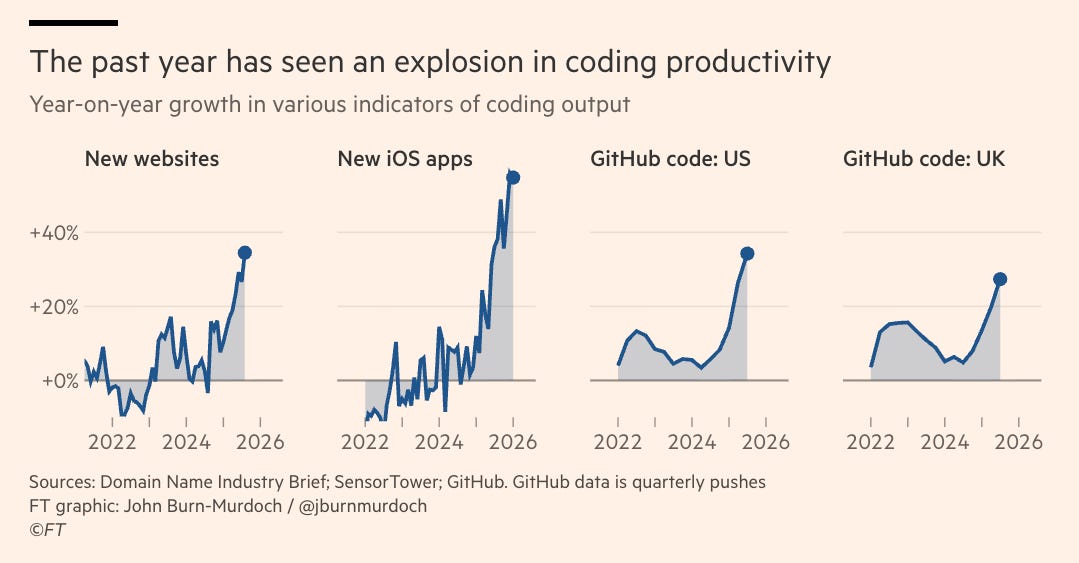
One person can now build what once required five. That does not just increase output. It increases builders.
And when builders increase, markets change.
This has happened before. In England before 1639, annual press output peaked around 500 items a year. By 1642, it was over 4,000. An eightfold jump in three years. Not because writers got faster. Because the cost of publishing collapsed and more people could do it.
The scribes’ guilds fought it. They saw their monopoly on book production threatened and resisted. You can see the same instinct today among professional engineers watching non-programmers ship apps through v0, Lovable, and Replit, redefining what “developer” even means.
This, I think, is the deeper parallel. Before the press, serious work was written in Latin. The press made publishing in local languages viable. English, German, French exploded as literary languages. The gatekeeping was not just about who could copy. It was about what language you had to speak to participate. AI coding is doing the same thing. Natural language is becoming the interface to programming. You no longer need to speak Python or Java or Go to build.
The flood came regardless. And here is the part I think most people miss.
When production becomes abundant, the hard part moves. It is no longer code. It is attention. Trust. Distribution.
Gatekeepers do not disappear in abundance. They relocate.
The Church first embraced it. Then they realized it weakened control. Within decades, they were licensing printers, banning books, and burning the ones they could not control. The gatekeepers did not vanish. They reorganized around a new choke point: not who could write, but who was allowed to publish.
Software used to require teams to ship. That requirement was the gate. Now platforms decide what gets seen. App stores, algorithms, search rankings, feeds.
Creation decentralizes. Discovery centralizes.
I can see the change in realtime. I use these tools to build MVPs myself. My engineer friends have done the same.
Everyone I talk to is sitting on projects they have not even shipped yet.
It was already hard to get traction before. When this backlog surfaces (and it will), the problem compounds.
The spike in new apps and websites is just what is visible. The real wave has not hit yet.
The printing press did not make the best writers win. It made the best distributors win. Publishers, universities, and journals emerged not because they wrote better. They filtered better.
If that pattern holds (and I believe it does), the question every builder should be asking is not “what should I build?”
It is “how will anyone find it?”